Free · Indonesia
Where to Find Indonesia Earthquake and Weather Alerts
Indonesia is too large and varied for a single weather icon or an old “best season” rule to guide a real journey. Conditions can differ across provinces, islands, coasts and mountain areas. Earthquake information creates another problem: a report that an earthquake occurred is not automatically a warning that your exact location faces a tsunami or severe damage.
The most useful skill is not memorizing every hazard. It is knowing which official information answers which question, and then reading its place and time before acting.
Indonesia's Agency for Meteorology, Climatology, and Geophysics—BMKG—publishes weather forecasts and warnings, earthquake information, tsunami-related information, climate information, and the official Info BMKG application. This guide shows how to use those sources without treating every update as the same kind of message.
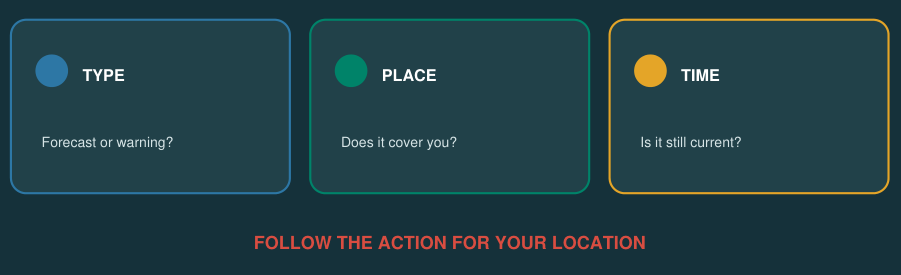
First check the information type. Then check the place. Then check the time. Then follow the action issued for your location.
This article is not a live warning. If an official alert, local evacuation instruction, or natural danger sign conflicts with a travel plan, the safety instruction takes priority.
Build a four-source official information set
Save these before you need them:
- BMKG location weather forecast — for expected conditions at a selected place.
- BMKG active weather early warnings — for current province- or area-specific warnings.
- BMKG earthquake information — for official event parameters and updates.
- BMKG/InaTEWS tsunami information and local evacuation instructions — for coastal earthquake and tsunami action.
The official Info BMKG application can place weather, climate, air-quality and earthquake information in one mobile channel. An app is useful, but it is not your only layer. Notification permissions, location settings, battery restrictions, connectivity, and language can all affect what you notice.
Keep at least one offline layer too: your accommodation address, a local meeting point, an identified evacuation route if relevant, and the contact method for your accommodation or tour operator.
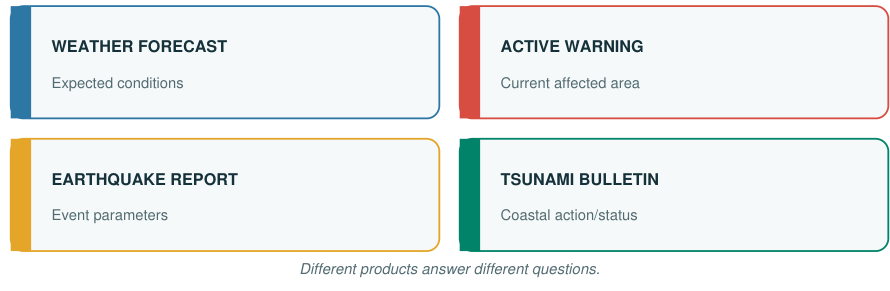
Forecast, warning, and event report are different products
Weather forecast
A forecast describes expected conditions for a place and period. It helps you plan departure time, clothing, water, shelter, and route alternatives. It is not proof that rain, wind, or heat will occur exactly as shown at your street or beach.
Use BMKG's weather forecast page by selecting the correct province and locality. Before making a decision, check:
- place name;
- date and local time shown;
- forecast period;
- weather condition;
- temperature and humidity when relevant;
- whether a separate active warning applies.
Weather early warning
BMKG's weather early-warning page displays active provincial warnings and detail areas. These warnings can describe moderate-to-heavy rain, lightning, strong winds, or other hazardous conditions for named areas and periods.
BMKG describes this product as nowcasting for the current situation and very short-range extreme-weather potential, generally covering the next 0–6 hours. That makes the issue time, update time and stated validity period essential. Do not save a warning in the morning and assume it still governs an evening journey; reopen the current province page.
A warning is more urgent and targeted than a general forecast, but it still must match your location. A warning for one province or district does not automatically describe another island with a similar weather icon.
Extreme-weather potential outlook
BMKG also publishes short-range potential outlooks for extreme weather. These are useful for seeing where elevated potential exists over the next several days. They do not replace a current warning or a local operational decision from a port, airline, park, accommodation, school, or authority.
Earthquake event information
BMKG's earthquake pages include categories such as recent events, felt earthquakes, real-time data, larger events, and events with tsunami potential. An entry may show:
- event time;
- magnitude;
- depth;
- coordinates;
- a described location;
- where shaking was reported or estimated;
- tsunami-potential information when relevant;
- later parameter updates.
An earthquake listing answers “what event has BMKG detected and analysed?” It does not by itself answer “is my building safe?” or “should I go to the beach to look?”
The real-time earthquake feed is a preliminary automatic product. BMKG warns that parameters in the first minutes can change and may not yet be accurate until reviewed or reanalysed by a seismologist. Use the real-time feed for awareness, but use BMKG's reviewed event information and verified InaTEWS bulletins for consequential decisions. Never treat a changing preliminary magnitude, depth or location as an evacuation cancellation.
Tsunami warning or information
Tsunami information is its own decision stream. Read the BMKG/InaTEWS warning bulletin, observation update or warning termination and follow local instructions. Do not infer “no risk” from an ordinary earthquake list, a preliminary real-time parameter, a social-media comment, or the absence of a phone notification.
For a near-coast event, natural warning signs can require immediate action before a message reaches you. BMKG guidance says that after a strongly felt coastal earthquake, people should move quickly inland and to higher ground; a local tsunami can arrive within minutes. Follow marked routes and local authority instructions rather than waiting on a beach for confirmation.
The six-field alert check
When a message appears, read these six fields before forwarding or acting on it.
1. Source
Is it an official BMKG or InaTEWS page, the official Info BMKG application, or a verified local authority channel? A screenshot without a visible source or link can be old, cropped, edited, or about another place.
2. Product type
Is it a forecast, active warning, outlook, earthquake event record, tsunami warning, cancellation/update, or educational post? Do not turn an outlook into a present emergency or an event record into a personal all-clear.
3. Issue and update time
Find when the message was issued and whether it has been updated. Indonesia spans multiple time zones, and BMKG pages label times accordingly. Keep the time-zone label with the time; do not copy only the hour.
4. Valid period
For weather, find the start and end of the warning or forecast period. A warning can expire, be extended, or be replaced. For earthquakes, newer analysis may update parameters.
5. Exact affected place
Match province, district/city, subdistrict, coast, sea area, or other named zone to your actual position and planned route. If you are moving between islands, check the origin, transfer point, sea/air route, and destination—not only the hotel.
6. Required or recommended action
Read what the authority says to do. “Potential,” “warning,” “felt,” and “evacuate” are not interchangeable. Local police, disaster-management offices, port authorities, park managers, accommodation staff, or other authorities may issue site-specific instructions.
Use this one-line record:
Source: ______ | Type: ______ | Issued: ______ | Valid: ______ | Place: ______ | Action: ______
A weather check that takes two minutes
Before a road trip, ferry connection, hike, island transfer, outdoor tour, or exposed walk:
- Open BMKG's forecast for your actual locality.
- Check the active weather-warning page for the province and detail area.
- Check the extreme-weather outlook if planning beyond the immediate period.
- Check any route-specific marine, port, airline, park, or operator notice.
- Decide the trigger that will change your plan.
Examples of useful triggers:
- “If an active warning covers the road and departure period, we delay and ask the operator.”
- “If the ferry operator suspends the sailing, we use the identified overnight plan.”
- “If lightning or strong winds develop, we leave the exposed ridge and use the sheltered route.”
- “If the destination warning is active, we do not assume clear weather at the origin describes the whole trip.”
Avoid the weak trigger “if the weather looks bad.” Define what information source or observed condition will make you change course.
After you feel an earthquake
Your first task during shaking is immediate physical safety, not opening an app. Protect yourself from falling objects and building hazards according to the situation and local guidance.
After shaking:
- Check yourself and people nearby for injury.
- Leave a damaged building in an orderly way when safe; do not use a lift.
- Watch for fire, gas, electrical, structural, and falling-object hazards.
- Expect possible aftershocks and avoid re-entering a damaged structure.
- Obtain official BMKG/InaTEWS and local-authority information.
- In a coastal danger area, respond to strong or long shaking and other natural tsunami signs by moving inland or to higher ground without waiting for a phone alert.
- Do not travel toward the coast, damaged area, or emergency route to investigate.
An earthquake magnitude alone cannot tell a visitor what a particular building, road, coast, or island will experience. Distance, depth, local ground conditions, construction, and the event mechanism all matter. Use official impact and tsunami information and follow local instructions.
Three common alert-reading mistakes
Mistake 1: forwarding an old warning as current
A screenshot says heavy rain is expected, but the issue date and valid period are cropped out.
Better response: find the current official page. Compare the locality and validity period. Forward the official link with the time you checked it.
Mistake 2: treating “earthquake occurred” as “tsunami expected”
You see a magnitude figure in a chat group and someone writes “tsunami.”
Better response: use BMKG/InaTEWS tsunami information and local instructions. If you are on the coast and experience strong or long shaking or other natural warning signs, evacuate promptly rather than debating an unofficial post.
Mistake 3: checking only the destination
The island destination forecast looks calm, so you assume the ferry journey is unaffected.
Better response: check origin weather, route or marine conditions, destination conditions, and the operator's actual status. A safe destination does not guarantee an operating connection.
Set up your phone without depending on it
Before travel
- [ ] Install the official Info BMKG application from a verified app-store listing linked by BMKG.
- [ ] Review its notification, location, background-data, and battery settings.
- [ ] Bookmark BMKG weather warnings and earthquake information in a browser.
- [ ] Save the accommodation address and province offline.
- [ ] Ask the accommodation about the nearest assembly point and, if coastal, the local tsunami route.
- [ ] Download an offline map for the immediate area.
- [ ] Carry a power bank and suitable charging cable.
Test once
Open the app or site and locate:
- your current locality forecast;
- the active weather-warning page;
- the earthquake-information page;
- the timestamp and location fields.
Do this in calm conditions. A tool you have never opened is not yet part of your emergency plan.
Keep a second layer
Write or screenshot only the stable items:
- accommodation name and address;
- local meeting point;
- evacuation route or higher-ground direction if applicable;
- trusted contact;
- travel provider's verified channel.
Do not save a weather forecast as if it were a permanent instruction. Recheck live information.
A compact decision table
| What you observe | Official information to check | Immediate planning question |
|---|---|---|
| Ordinary trip tomorrow | BMKG locality forecast and outlook | What time/route alternative reduces exposure? |
| Active rain, lightning, or wind warning | BMKG active warning plus local/route operator | Does the warning cover my place and travel period? |
| Ferry or coastal trip | BMKG weather/marine information plus operator/port | Is the route operating, and what is the safe fallback? |
| Earthquake felt | Immediate physical safety, then BMKG earthquake/InaTEWS and local authority | Is there damage, a coastal evacuation need, or a local instruction? |
| Coastal strong/long shaking or natural tsunami sign | Evacuate inland/higher ground; heed local routes and official warnings | What is the fastest safe route away from the coast? |
| Viral alert screenshot | Current official page | Is the source, place, time and status genuine and current? |
Travel-day alert card
Complete this for the actual location—not “Indonesia” generally.
Today’s place/province: __________________________________________
Planned route and destination: ___________________________________
BMKG forecast checked at: ________________________________________
Active weather warning: None shown / Yes / Could not verify
Warning place and valid period: __________________________________
Operator/local-authority status checked at: _______________________
My change-plan trigger: __________________________________________
Safe indoor pause or overnight fallback: __________________________
If coastal, local evacuation direction/assembly point: ____________
Trusted contact: __________________________________________________
Official sources checked
These pages were checked on 25 October 2026. They are dynamic; use their current content when making a decision.
- BMKG, Weather Forecast: https://www.bmkg.go.id/cuaca/prakiraan-cuaca
- BMKG, Active Weather Early Warnings: https://www.bmkg.go.id/cuaca/peringatan-dini-cuaca
- BMKG, Extreme Weather Potential: https://www.bmkg.go.id/cuaca/potensi-cuaca-ekstrem
- BMKG, Latest Earthquake Information: https://www.bmkg.go.id/gempabumi
- BMKG, Real-time Earthquake Information: https://www.bmkg.go.id/gempabumi/gempabumi-realtime
- BMKG, Earthquakes With Tsunami Potential: https://www.bmkg.go.id/gempabumi/berpotensi-tsunami
- BMKG InaTEWS, Verified tsunami warning bulletins, observations and terminations: https://inatews.bmkg.go.id/eng/tsunami
- BMKG InaTEWS, Preliminary real-time earthquake monitor: https://inatews.bmkg.go.id/eng/realtime
- BMKG, Info BMKG Application Privacy Policy: https://www.bmkg.go.id/kebijakan-privasi
- BMKG, Earthquake and Tsunami Preparedness Education: https://www.bmkg.go.id/gempabumi/mitigasi/edukasi-gempabumi-tsunami
Official warnings and local authority instructions control where they differ from this general guide. Do not use this article as a live forecast, warning, or evacuation order.